
Affective governmentality and anti-gender politics
31. 3. 2026 | Gender

At the international conference “Anti-gender movements and their narratives,” Leja Markelj presented a paper titled Affective Governmentality and Anti-Gender Politics: Parliamentary Debates on LGBTIQ+ and Reproductive Rights in Slovenia, co-authored with Dr. Mojca Pajnik. In this paper, the authors examine anti-gender discourse within Slovenian parliamentary debates concerning LGBTIQ+ and reproductive rights between 2010 and 2024. The analysis reveals that anti-gender actors are not confined to extra-institutional activities but also actively participate in parliamentary processes. In doing so, they establish an affective regime in which anger, fear, and compassion function as mechanisms of “affective governmentality.” Through these, they warn against the spread of so-called “gender theory”—allegedly a threat to the heteronormative family and the interests of children—which they claim contributes to the extinction of the nation and restricts women’s rights. The research highlights that affects and emotions, as political tools, play a crucial role in advancing anti-gender agendas, with parliamentary debates serving as a significant space for their legitimation.
The research was conducted as part of the fundamental research project “Gender, Democracy, and the Neoconservative Anti-Gender Movement” (J5-50158).
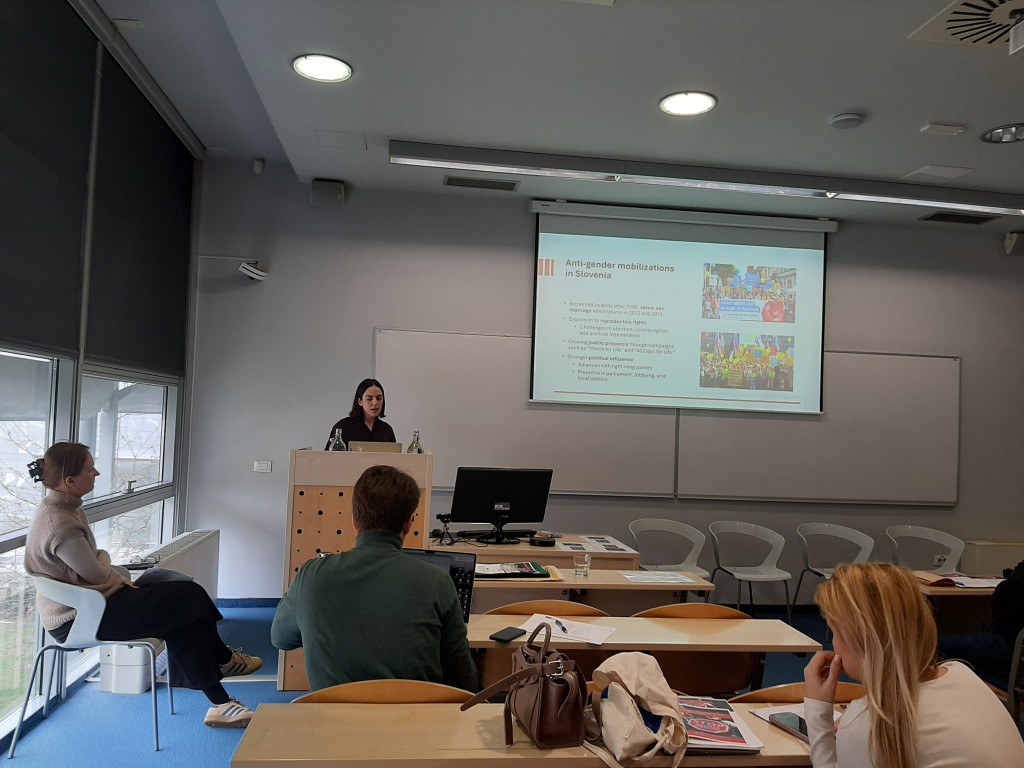
About the conference:
The conference took place on March 26 and 27, 2026, at the Faculty of Social Sciences in Ljubljana. It focused on the rise and consolidation of the so-called… …anti-gender movements in Europe and the wider world over the last decade. These are neo-conservative political mobilizations that oppose equality policies, framing them as a threat to society, the family, and the “natural order.” These movements bring together diverse actors—ranging from religious organizations and civil society initiatives to far-right political parties, nationalist groups, and individuals who present themselves as “concerned citizens.” Their common thread is the concept of “gender ideology,” which enables cooperation among actors with varied ideological and political backgrounds through shared narratives—often rooted in oversimplified notions of gender and sexuality, as well as the mobilization of fear and moral panic.
At the conference, researchers from the Czech Republic, Croatia, Bosnia and Herzegovina, Austria, and Slovenia presented the latest findings from their research on neo-conservative and anti-gender mobilizations.
The conference was held within the framework of the projects “Gender, Democracy and the Neo-conservative Anti-gender Movement” and “AntiGenderInBiH – Anti-democratic/Anti-gender Nexus in Bosnia and Herzegovina.”
Related Articles
-

Between Public Expectations and the Structural Challenges Facing Journalism
-

Presenting Research on Solidarity Networks and Refugee Housing Experiences in Ljubljana
-

How Publics Navigate the Digital Media Environment
-
Researchers from the Peace Institute on the Citizens’ Parliament as an Innovative Democratic and Research Method