
Ljubljana can be a city for everyone: to create an inclusive living environment, it is essential to ensure that everyone feels equal and on an equal footing within it
31. 5. 2024 | Human Rights and Minorities

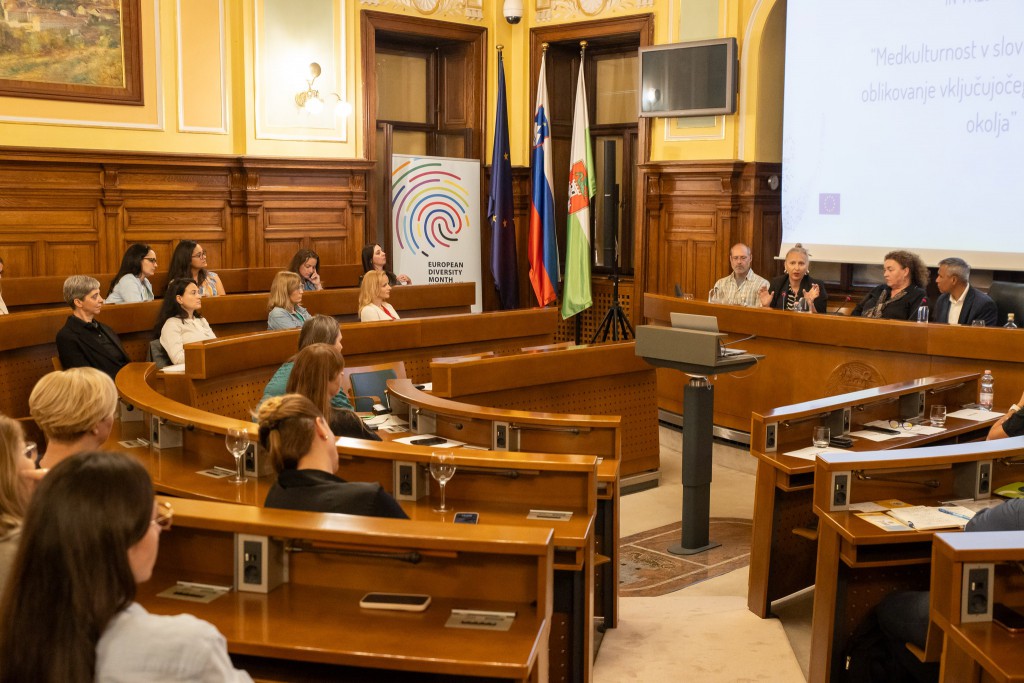
Lana Zdravković participated in a roundtable discussion titled “Interculturalism in Slovenian Society and the Creation of an Inclusive Living Environment,” organized on May 29 by the Diversity Charter Slovenia in collaboration with the City of Ljubljana, as part of an event focused on intercultural diversity and inclusion.
During the discussion, she highlighted that creating an inclusive living environment requires ensuring that everyone feels equal and possesses equal rights within it. She pointed out that migrants make up more than 13% of Ljubljana’s population, and emphasized the critical role of the local community in the integration process—a process that is inherently two-way. Integration takes place where people live, work, attend kindergarten and school, visit doctors, cultural events, restaurants, and cafés; it happens where they spend their leisure time, socialize, have fun, and pay taxes. Effective integration policies should be designed to enable migrants to achieve self-sufficiency as quickly as possible, as only empowered individuals can fully participate in co-creating society. The more migrants feel at home in their environment, the more they will contribute to its development, improvement, and collective well-being. Based on several research projects and long-standing cooperation with migrant and minority communities and organizations, Lana Zdravković has highlighted five key areas of integration that should be improved at the local level:
– Language courses for migrants are essential. They should be more accessible and offer more instructional hours—especially for those coming from non-Slavic language groups (such as speakers of Turkish, Arabic, Farsi, or languages from South America)—as these individuals require more time to learn Slovenian. At the Peace Institute, we also advocate for the right to unlimited, free Slovenian language instruction for everyone who wishes to learn the language.
– Social housing for migrants is a necessity, as they are currently excluded from social programs designed to provide non-profit housing. Families with many children are particularly vulnerable. Conditions in the real estate market are daunting—with exorbitant rents and the presence of discrimination—making it urgent to take action in this area.
– Funding for migrant and minority organizations could be supported through dedicated calls for proposals; currently, these groups must compete against large, well-established NGOs, which effectively creates a form of unfair competition.
– Migrants also face a lack of infrastructure and physical space for their activities, meetings, and social interaction—both among themselves and with the local population. Community spaces would facilitate getting to know one another, social inclusion, and intercultural connection; therefore, they are urgently needed.
– The broader political issue of racism, discrimination, and stigmatization must be addressed structurally and in the long term through awareness-raising campaigns, systemic support, education, and positive measures that promote and ensure equality and equal rights. The integration of migrants and anti-racist policies are interconnected and must go hand in hand.
Related Articles
-
Who Cares for Older People? The Transnationalization of Care Work in Central and Eastern Europe
-
Integration in Slovenia – Key Findings Presented at the 10th African Village Festival
-
The mobility of care work between Slovenia and Bosnia and Herzegovina
-
Empowering Migrant Voices in Local Integration and Inclusion Processes: Good Practices of Local Integration in Luxembourg