
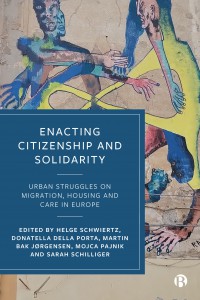
Book / Enacting Citizenship and Solidarity: Urban Struggles on Migration, Housing and Care in Europe
Bristol University Press has published Enacting Citizenship and Solidarity: Urban Struggles on Migration, Housing and Care in Europe, edited by Helge Schwiertz, Donatella della Porta, Martin Bak Jørgensen, Mojca Pajnik and Sarah Schilliger. The book includes chapters by Anteja Tomašič and Mojca Pajnik on solidarity networks, access to housing and the creation of a sense of home among refugees in Ljubljana, and by Marko Ribać on practices of self-organisation in Maribor.
Drawing on ethnographic research in eleven European cities, the book explores how local initiatives and activist organising create new forms of solidarity and enact citizenship through everyday practices. Bringing together questions of migrants’ rights, housing policy and care, it shows how collective action – from community kitchens to housing rights struggles and self-organised residents’ assemblies – challenges social exclusion, strengthens a sense of belonging and opens up spaces for new forms of democratic participation.
In their chapter Solidarity Networks and Spaces of Hope: Refugee Housing in Ljubljana, Anteja Tomašič and Mojca Pajnik explore how access to housing and the creation of a sense of home among refugees in Ljubljana intersect with solidarity and struggles for housing justice. Drawing on ethnographic research and interviews with refugees, homeowners and civil society actors, they analyse everyday practices that foster connections, mutual support and belonging despite structural barriers. Through the concept of ‘affective homing’, they highlight the importance of emotional and social ties through which physical accommodation becomes a home. They show how ‘spaces of hope’ emerge at the intersection of these ties, solidarity practices and struggles for housing justice, enabling refugees to help shape their living conditions and imagine their futures. By foregrounding the emotional, social and political dimensions of housing, they invite reflection on housing policies and practices that centre refugees’ lived experiences.
Marko Ribać examines Iniciativa mestni zbor (IMZ) in Maribor and its role in establishing and sustaining shared spaces for democratic decision-making. Through an analysis of assemblies, community gardens and efforts to introduce participatory budgeting, he shows how the initiative creates conditions for public debate, horizontal organising and residents’ participation in governing the city. He presents IMZ as an important custodian of the communicative and political infrastructure that enables residents to exercise their right to the city. He also highlights the extensive, often invisible labour required to sustain these practices, alongside the challenges of maintaining residents’ long-term engagement in self-organised forms of democratic decision-making.
Mojca Pajnik also co-authored the introductory and concluding chapters, which establish a framework for understanding citizenship and solidarity and, by comparing practices across migration, housing and care, highlight the potential of urban struggles to bring about social change.
The book is an outcome of the research project Enacting Citizenship and Solidarity in Europe ‘From Below’: Local Initiatives, Intersectional Strategies, and Transnational Networks (ECSEuro), funded by the Volkswagen Foundation from 2022 to 2025.
The book is available open access.